
Who is Jensen Huang?
Currently reading the book “Thinking Machines” (Witt et al., 2025) , a biography of the NVIDIA’s CEO, Jensen Huang. I noticed this big quote from the prolog:
Practice even what seems impossible.
Marcus Aurelius Antonius
Early days of NVIDIA
One might say that the most inspiring stories from building a company comes from the point where it begins from zero. How does the story of Jensen Huang start?
The mother of success is desperation.
Our company is thirty days from going out of business.
Huang regularly began presentations to Nvidia staff with those words for many years, regarding the “pain and suffering” of Nvidia’s early years developing the RIVA128 (NV3) as essential to the company’s success in later years.
In mid-1996, Jensen was due to deliver a working prototype of NVIDIA’s NV2 console to Sega in exchange for 1 million USD. Jensen told Sega that while NVIDIA’s alliance with Microsoft meant they wouldn’t be involved in the Dreamcast’s development, the delivery of the prototype fulfilled the technical terms of the contract and demanded payment. He added that failing to do so would lead to NVIDIA’s bankruptcy. Sega, surprisingly, paid the money without any conditions.
As soon as Jensen received the payment, he used the last of Nvidia’s funds to purchase an emulator. With the company already under financial emergency measures, emulation was a risky gamble. If even one of the 3.5 million transistors in the upcoming NV3 chip were misaligned, it could have failed in mass production and potentially wiped out the company.
By early 1997, the NV3 had reached the tape-out stage, and the design drawings were sent to a European semiconductor factory for production. It’s hard to imagine the joy he felt when the completed NV3 chip arrived in late spring, delivering a flawlessly smooth 30 frames per second display.
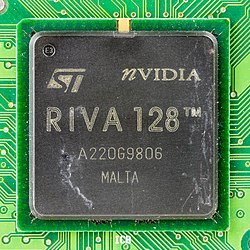 NVIDIA RIVA 128 CHIP
While the NV3 was largely a chip that copied existing functions, it featured the following innovations:
It transferred data from memory to the processor at a speed of 128 bits, twice the industry standard.
It was versatile enough to accelerate video games, but also expand spreadsheets and play DVDs. To highlight this breadth of functionality, the NV3 was branded the “RIVA128” (Real-Time Interactive Video and Animation accelerator).
By the time the product arrived in stores in August 1997, NVIDIA was practically running out of gas. Fortunately, reviewers were positive about the RIVA128. “Capable of rendering up to 5 million triangles per second, this is the best accelerator money can buy.” Fueled by these positive reviews, NVIDIA sold over a million RIVA cards within the first four months of its release.
The Dawn of the Graphics Wars
There’s also a story about John Carmack. The lead programmer for
Leaving out the details, let’s consider the following equation:
\[f(x) = \frac{1}{\sqrt{x}}\]An ordinary programmer would write something like this:
1
2
#include <math.h>
float y = 1 / sqrt(x);
Carmack’s team writes:
1
2
3
4
5
6
7
8
9
10
11
12
13
14
15
float Q_rsqrt( float number )
{
	long i;
	float x2, y;
	const float threehalfs = 1.5F;

	x2 = number * 0.5F;
	y = number;
	i = * ( long * ) & y;
	i = 0x5f3759df - ( i >> 1);
	y = * (float * ) &i;
	y = y * ( threehalfs - ( x2 * y * y) );		// 1st iteration
//	y = y * ( threehalfs - ( x2 * y * y) );		// 2nd iteration, can be removed

}
In fact, accuracy is at 99%, and speed is four times faster.
I’ll explain the backstory behind this bizarre code later.
The important thing is that David Kirk, a senior engineer at NVIDIA, said this.
It was becoming clear that whichever company could best render this particular game (Quake) would win the graphics war.
David Kirk, NVIDIA
Jensen instructed the development team to create a new chip just for John Carmack.
One of Carmack’s priorities was multiple “pixel shaders,” the algorithms that colorize each pixel in games like Quake. Running multiple shaders simultaneously would allow for the simultaneous addition of textures like light reflections on walls and blood splatters on them. Of course, this dual shader architecture required twice as much computational power.
3dfx, then a dominant player in the graphics accelerator market, solved this problem by integrating two graphics chips onto the same circuit board. Instead, David and his team sought to use a “parallel computing” approach: splitting pixel shading tasks into two data sets and executing each operation simultaneously on the same instruction set. Jensen was initially skeptical.
Silicon Valley, it’s littered with corpses of previous parallel-computing platform companies. Not one parallel-computing company has ever been created with the exception of us—not one, zero.
Jensen Huang
The list of ‘corpses’ included:
- Seymour Cray’s powerful parallel supercomputers were too expensive and customers complained they were too complicated.
- nCube, a parallel computing startup in which Oracle founder Larry Ellison invested millions of dollars, also failed in the late 1990s.
The problem was that parallel programming was difficult. Simultaneously processing two or more data streams required moving between multiple memory banks, a process that was extremely complex. This led to parallel computing companies being pushed out by Intel.
…
In June 1998, the “RIVA TNT” was released. TNT stood for “Twin Texels,” signifying a dual-pixel rendering pipeline controlled by a sophisticated switching mechanism. John Carmack was thrilled by this, calling it “the perfect card.” He designed
References
- Witt, S., Gebauer, S., & Verlag, C. (2025). The thinking machine: Jensen Huang, Nvidia und der begehrteste Mikrochip der Welt. Campus Verlag. https://books.google.co.kr/books?id=3un80AEACAAJ